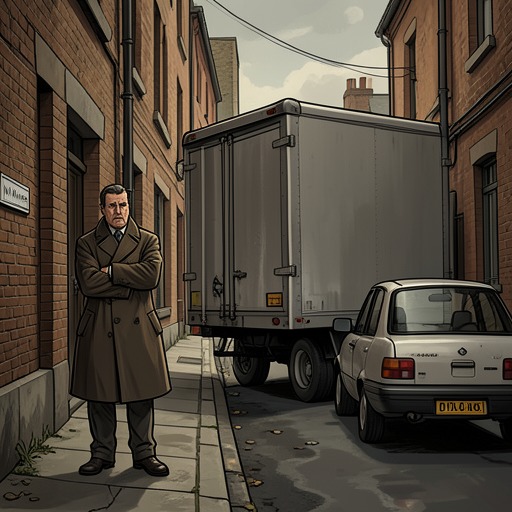
Ove attempts suicide with car exhaust, then drives Parvaneh’s family to the hospital
A Man Called OveOve’s attempt to die by car exhaust is interrupted by Parvaneh’s request for help, turning a meticulously prepared suicide plan into an urgent drive to the hospital. The reversal does not settle his grief or end his suicidal thinking. It does, however, make the responsibility he resists impossible to ignore: when his pregnant neighbor needs him, Ove acts on what he believes Sonja would have asked him to do.
Background and Preparation
Ove has delayed his plan for six months after Sonja’s death. She died on a Friday and was buried on Sunday; he went to work on Monday because, in his view, that was how one handled things. Six months later, the managers arrived on a Monday to tell him they had postponed the news until after the weekend. The loss of his job leaves him without the daily duty that had helped him put off his grief. He had once told himself that people could not simply stop going to work because they had killed themselves. Now he is no longer going to work, and he sees little reason to wait.
His preparations are characteristic in their thoroughness. He pays the undertakers and arranges a place in the churchyard beside Sonja. He contacts the lawyers and writes clear instructions, placing the letter with important receipts, the house deeds, and the Saab’s service history in his jacket pocket. He pays every bill, has no loans or debts to leave behind, washes his coffee cup, and cancels the newspaper subscription. Even the car’s future is accounted for: his letter specifies where its summer tires are stored and where to find the rim bolts. The practical care with which he arranges his affairs contrasts with his conviction that his own life has no purpose left.
On the morning of the attempt, after spending much of the night considering methods and drawing diagrams, Ove settles on using the Saab. He first clears the path between the house and shed, taking fifteen minutes to shovel it in straight lines with even edges. He then eats breakfast, listens to the radio, washes up, checks the radiators, turns off the lights, and makes sure the coffee percolator is unplugged. Dressed in his good navy suit beneath a blue jacket, he locks the house and shed and checks each door handle three times. The routine gives the morning its ordinary shape even as he prepares for it to be his last.
The Attempt Is Interrupted
In the garage, Ove starts the Saab, leaves its engine running, and directs exhaust from the tailpipe through a plastic tube into the car. He adjusts the mirrors and radio and closes his eyes. The attempt is bound up with his sense that the life he and Sonja agreed to share has been put in the wrong order: he remembers their promise to stay together until death, but she died first. He wonders whether she will still see him as dependable now that he is unemployed and feels useless.
Banging at the garage door breaks into this inward reckoning. Ove ignores it at first, but when the pounding continues he opens the car door abruptly. The tube comes loose, and exhaust disperses through the garage. Parvaneh is standing close to the door; it strikes her in the face, leaving her with a nosebleed. She looks past the immediate mishap and asks Ove for a ride to the hospital. He initially dismisses the need, treating the bleeding as minor and objecting that he is not a transport service.
The emergency is larger than her injury. Patrick has fallen from a ladder and has already been taken to the hospital by ambulance. Parvaneh was not allowed to ride with him, and she has no driver’s license. With taxis occupied and buses struggling in the snow, she cannot get there herself. She tells Ove to prepare to leave while she goes to fetch the children. His objection that she should call an ambulance has no effect: she has already done so, and the ambulance has taken Patrick.
Choice and Consequences
Left with the running car and the exhaust tube, Ove recognizes that he could resume the attempt. Instead, he thinks about what Sonja would have told him to do. He does not need to reason it out for long. He knocks the tube from the exhaust pipe with his shoe, gets into the Saab, checks the mirrors, and pulls out of the parking area. He tells himself that he is not concerned with how Parvaneh gets to the hospital, and that he might as well use the fuel already being spent. Yet his decisive reason is his expectation that Sonja would condemn him if he left a pregnant woman stranded after causing her nosebleed.
The event’s change is immediate but limited: Ove moves from preparing to die to taking responsibility for a neighbor and her children. The familiar Saab, first arranged as the means of his death, becomes the means by which he answers a practical need. His rescue of the moment does not amount to recovery. Later, he again sits in the garage with the engine running and considers waiting for the fumes to end his life; the stray cat’s presence makes him turn the engine off. That recurrence makes clear that Parvaneh’s request interrupts the crisis rather than resolving the grief beneath it.
Narrative Significance
The interruption turns Ove’s fastidious habits against the finality he seeks. He has prepared instructions for tires, bills, and the house, but the neighbor who appears at his door introduces a need that cannot be filed away or settled in advance. His first responses are irritation and refusal; his eventual action comes from a standard of loyalty he associates with Sonja. Her absence remains the source of his despair, yet his memory of her also guides him back toward other people.
The Saab’s changed use gives the episode its sharpest contrast. Ove has considered the cost of fuel and the condition of the tires even while planning to end his life; once Parvaneh asks for help, the same car carries him out of the garage and toward an emergency. The shift is not presented as a sudden cure or a declaration of renewed hope. It is a concrete act of care, made before Ove can persuade himself that he wants to live. In this episode, responsibility does not erase his wish to die; it interrupts it long enough for him to be needed.